
In 2025, the World Health Organization did something it had never done before. It convened a Commission on Social Connection and published a report naming loneliness as a global health priority in its own right, not a side effect of something else.
The numbers are hard to look away from. One in six people worldwide report feeling lonely. Loneliness is associated with roughly 871,000 deaths a year, around 100 an hour, a mortality risk that rivals smoking.
That’s the headline most people have already half-absorbed. Here’s the part almost nobody is connecting to it.
Key Takeaways
- The WHO’s 2025 Commission on Social Connection report links loneliness and social isolation to approximately 871,000 deaths a year worldwide, a mortality risk comparable to smoking.
- A 2026 cultural trend called “friction-maxxing,” coined by journalist Kathryn Jezer-Morton, describes people deliberately choosing in-person, inconvenient connection over frictionless digital convenience, without being told to.
- Separately, Tufts University researcher Dr. Michael Levin has spent over two decades building a peer-reviewed case that individual cells coordinate into a body using bioelectric signaling he calls “cognitive glue.”
- Levin’s own published language describes the body as a collective intelligence: cells cooperating toward goals that belong to the whole, not to any individual cell.
- His lab’s research explicitly connects disruption of this bioelectric coordination to embryogenesis, regeneration, aging, and cancer suppression.
- These are two separate, independently credible bodies of research. Neither claims the other causes it. What they share is a pattern: coordination breaking down at one scale looks remarkably like coordination breaking down at another.
A Crisis With a Name, Finally
Loneliness used to be treated as a private sadness, something to manage quietly. The WHO’s report reclassified it as a measurable public health threat with its own mortality signature, on par with major known risk factors, and linked to higher rates of stroke, heart disease, and cognitive decline.
Something else showed up in the same cultural moment, without the WHO’s involvement at all. In early 2026, writer Kathryn Jezer-Morton coined the term “friction-maxxing” to describe a trend she was seeing everywhere: people deliberately choosing the harder, slower, more inconvenient version of things, calling instead of texting, meeting in person instead of messaging, specifically to preserve something real contact gives them that convenience quietly strips away.
Nobody organized this. It shows up in think pieces, in social media, in casual conversation, as something people are reaching for on their own, before anyone told them to.
A Parallel Nobody’s Naming
Here’s where it gets interesting.
Dr. Michael Levin runs a lab at Tufts University, with an additional appointment at Harvard’s Wyss Institute for Biologically Inspired Engineering. For over twenty years, his research has asked a basic question: how do individual cells, each with no awareness of the whole, cooperate to build and maintain a single coherent body?
His answer, published across dozens of peer-reviewed papers, centers on bioelectric signaling, the voltage patterns cells use to communicate with their neighbors. Levin’s own term for this is “cognitive glue.” In his words, bioelectric networks bind individual cells into a collective intelligence, one capable of pursuing goals, like building a precise anatomical structure, that belong to the group and don’t exist in any single cell on its own (McMillen & Levin, Communications Biology, 2024).
This isn’t a metaphor borrowed for effect. It’s the literal framing used in his published work, including a dedicated paper titled “Bioelectric networks: the cognitive glue enabling evolutionary scaling from physiology to mind,” published in the peer-reviewed journal Animal Cognition (Levin, Animal Cognition, 2023).
Where Aging Fits In
Levin’s lab doesn’t stop at description. Their research explicitly ties this bioelectric coordination to some of biology’s hardest problems. As his own lab summary states, groups of cells “solve problems across embryogenesis, regeneration, aging, and cancer suppression, using bioelectrical networks to store setpoint patterns” (Levin, BIOEM biography).
In plain terms: the same communication system that tells your cells how to build a working body in the first place appears to be involved in what goes wrong when that body ages, fails to regenerate properly, or develops cancer. Disruption of coordination isn’t incidental to these processes. It shows up as a recurring thread across all of them.
What This Doesn’t Prove Yet
This is the part worth being precise about, because the parallel here is genuinely interesting, and genuinely easy to overstate.
The WHO’s loneliness research and Levin’s bioelectric research are two completely separate fields, studied by different scientists, publishing in different journals, with no claimed causal link between them. Nobody in either field is arguing that social loneliness causes cellular bioelectric disruption, or that fixing one would fix the other. That connection doesn’t exist in the published research, and claiming it does would misrepresent both bodies of work.
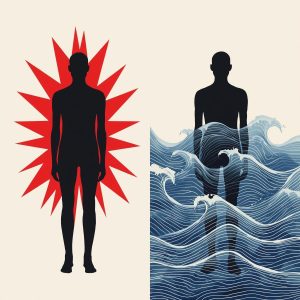
What does exist, and what’s fair to point out, is a shared pattern. At the scale of a society, coordination between people breaking down correlates with serious, measurable harm. At the scale of a body, coordination between cells breaking down correlates with serious, measurable harm, including the processes we call aging. Two real findings, at two different scales, both pointing at the same underlying shape: connection sustains complex systems, and its absence costs them.
Where This Leaves Us
Science built much of its power by taking systems apart to study the pieces in isolation. That approach produced real knowledge, including everything in this piece. But it also carried a quiet assumption most of us never examined: that once you’ve described the parts, you’ve described the whole.
Levin’s own research argues otherwise, at the level of a single body. The WHO’s report argues otherwise, at the level of a society. Neither proves the other. But it’s hard to look at both at once and not notice the same question showing up twice.
Not because separation is a flaw to be fixed.
But because coordination, at every scale anyone has thought to measure it, is what keeps a system whole.
Frequently Asked Questions
What does the WHO’s report actually say about loneliness?
The WHO’s 2025 Commission on Social Connection report found that one in six people worldwide experience loneliness, and that loneliness and social isolation are associated with approximately 871,000 deaths a year, a mortality risk comparable to smoking. It also links loneliness to higher rates of stroke, heart disease, and cognitive decline.
Who is Michael Levin and what is bioelectric “cognitive glue”?
Dr. Michael Levin is a researcher at Tufts University and Harvard’s Wyss Institute who studies how individual cells coordinate to build and maintain a body. His published research describes bioelectric signaling, voltage patterns cells use to communicate, as “cognitive glue” that binds cells into what he calls a collective intelligence.
Does this research prove loneliness causes cellular aging?
No. The WHO’s loneliness research and Levin’s bioelectric research are separate fields with no claimed causal link between them. Neither body of research argues that social loneliness causes cellular disruption, or that addressing one would resolve the other. What they share is a pattern of coordination breaking down at different scales, not a proven mechanism connecting the two.
What is “friction-maxxing”?
Friction-maxxing is a term coined by writer Kathryn Jezer-Morton in early 2026 to describe people deliberately choosing less convenient, more effortful forms of connection, calling instead of texting, meeting in person instead of messaging, in order to preserve something that frictionless digital convenience tends to strip away.
Is the connection between loneliness and cellular biology scientifically proven?
The connection described in this piece is a pattern observation, not a proven causal link. Both the WHO’s loneliness findings and Levin’s bioelectric research are independently well-documented and peer-reviewed within their own fields. The parallel between them, coordination sustaining complex systems at different scales, is an observation worth noting, not a claim that one body of research proves the other.
Sources
- WHO Commission on Social Connection — “From Loneliness to Social Connection”
- WHO News Release, June 30, 2025
- McMillen, P. & Levin, M. — “Collective intelligence: A unifying concept for integrating biology across scales and substrates,” Communications Biology, 2024
- Levin, M. — “Bioelectric networks: the cognitive glue enabling evolutionary scaling from physiology to mind,” Animal Cognition, 2023
- Michael Levin — Biography and research summary, BIOEM
- “Putting your phone aside in the year of friction-maxxing” — Here & Now / WBUR, 2026