

Key Takeaways
- → Emotions are not stored in the mind. They are stored in the body as neuropeptide receptor patterns. Dr. Candace Pert’s research showed every emotion has a corresponding molecule that docks at receptor sites throughout tissues, organs, and immune cells
- → Talk therapy alone cannot reach somatically stored trauma. The body holds emotional charge at a cellular level that language and cognition do not access
- → Frequency Specific Microcurrent targets specific tissue types with precise frequencies. Clinical results show measurable reductions in inflammatory cytokines and emotional charge held in fascial tissue within a single session
- → The gut contains over 100 million neurons and produces 95 percent of the body’s serotonin making it a primary emotional processing center not a secondary one
- → Healing stored emotion requires working at the frequency level of the body not just the narrative level of the mind. The body speaks in sensation not in story
6 min read · By Mikhail Ocean · The Frequency Healing Journal
Why Your Body Might Be Feeling What You Haven’t Even Remembered Yet
Your body keeps the score.
But what exactly is it keeping track of?
The answer lies in tiny molecular messengers called neuropeptides that most people have never heard of. These chemical compounds are rewriting everything we thought we knew about emotions, trauma, and healing.
Your Emotions Are Actually Molecules
Here’s what blew my mind when I first learned this: emotions aren’t just mental experiences. They’re physical molecules with real biological effects.
Dr. Candace Pert, the neuroscientist who discovered opiate receptors in the brain, revealed that neuropeptides are informational substances that create a psychosomatic network throughout our bodies. As she put it, “Emotions are literally changing the chemistry of every cell of your body.”
Think about that for a second. Every time you feel joy, fear, anger, or sadness, your body is producing specific molecules that travel through your bloodstream and attach to cells everywhere. Your gut. Your heart. Your immune system. Even your skin.
The Science That Changes Everything
Neuropeptides are nerve proteins that regulate almost all life processes of our cells and control how all cells communicate with each other. When you experience strong emotions repeatedly, these molecular patterns get stored in your tissues.
This isn’t new age thinking. It’s hardcore neuroscience.
Research shows that neuropeptides like NPY are highly expressed throughout limbic structures including the insula, hippocampus, and amygdala, playing crucial roles in trauma-related symptoms. Different neuropeptides can either promote or reduce depression and anxiety-like symptoms, depending on their specific functions.
Why Your Body Remembers What Your Mind Forgets 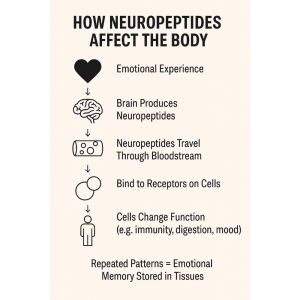
Here’s where it gets really interesting. Trauma can register within our bodies on a cellular level, especially when it happens before we have language or mature memory formation.
The emotional energy from these experiences doesn’t just disappear. It gets encoded in your tissues through neuropeptide patterns. This is why you might:
- Feel anxious in situations that seem perfectly safe
- Have chronic tension in specific parts of your body
- Experience digestive issues with no clear medical cause
- Feel emotionally “stuck” despite doing all the mental health work
Your body is literally holding onto emotional information from experiences you might not even consciously remember.
My Personal Journey: When Everything I Knew Stopped Working
I lived with this truth personally for decades.
I knew about my childhood traumas. I understood the abuse I’d experienced. I thought I was healing it through years of natural modalities, therapy, and self-care practices.
I was wrong.
Despite knowing intellectually what had happened to me and trying every healing approach I could find, my health collapsed. No amount of meditation, supplements, energy work, or lifestyle changes could restore my vitality. I felt trapped in a body that was holding onto decades of stored trauma, and nothing I did seemed to reach it.
That’s when frequency healing entered my life and changed everything.
The Breakthrough That Saved My Health: Frequency Specific Microcurrent
Frequency Specific Microcurrent (FSM) takes advantage of the body’s ability to respond to frequencies in order to heal a number of chronic conditions. What I discovered through FSM and other frequency modalities was that my body had been storing trauma at a cellular level that no other approach could access.
Dr. Carolyn McMakin developed Frequency Specific Microcurrent (FSM) in 1996 and began teaching it in 1997. She has a part-time practice, consults with and treats professional teams and elite athletes, and does clinical research and teaches FSM seminars in the US and abroad.
Her groundbreaking clinical research revealed something profound: specific frequencies can target specific tissues and address stored emotional patterns that have become embedded in our cellular structure.
In her book “The Resonance Effect,” Dr. McMakin explains how FSM can effectively treat a range of chronic conditions, including fibromyalgia, nerve and muscle pain, inflammation, diabetic wounds, liver disease, bowel inflammation, concussion, spasticity from brain injuries, and even PTSD.
How Frequencies Heal Where Other Methods Can’t
What makes frequency healing different is its ability to work at the cellular level where trauma is actually stored. While somatic therapies and other body-based approaches provide scientific proof that emotions live in tissues, frequency modalities can directly target and release these stored patterns.
The science behind this is remarkable. FSM uses frequencies and the power of resonance as holistic support for health and wellness. When the correct frequency is applied to specific tissues, it can literally dissolve the molecular patterns that have been holding trauma in place.
For me, this was the missing piece. After decades of trying to heal trauma through other methods, frequencies finally reached the cellular memories that nothing else could touch.
The Breakthrough Science Everyone Should Know
Research confirms what I experienced personally. Studies on frequency specific microcurrent therapy show it can produce measurable physiological changes in tissue healing and pain management.
But the implications go far beyond pain relief. When you understand that emotions are neuropeptide molecules stored in your tissues, frequency healing becomes a direct pathway to cellular-level emotional release.
Dr. McMakin’s clinical work demonstrates that specific frequencies can:
- Target stored trauma in specific tissues
- Reduce inflammation caused by emotional stress
- Restore healthy cellular communication
- Release patterns that have been stuck for decades
Why This Matters Now More Than Ever
We’re living in a time of unprecedented stress and disconnection. Understanding that our emotions have a physical reality helps explain why so many people feel stuck despite having intellectual insight into their problems.
The growing recognition of frequency healing modalities like FSM represents a paradigm shift in how we approach trauma recovery. It’s no longer enough to just talk about trauma or even work with it somatically. We need approaches that can reach the cellular level where trauma is actually stored.
The Message Your Body Is Trying to Send
Those physical sensations you feel – the tight chest, the knotted stomach, the tense shoulders – aren’t random. They’re your body’s way of communicating stored emotional information through neuropeptide patterns.
Learning to listen to these signals and having tools like frequency healing to actually release them is often the key to the deep healing that traditional approaches alone can’t provide.
The Bottom Line
Your body isn’t just carrying you around. It’s actively storing and processing emotional information through complex chemical networks. When you understand this body-mind connection and have access to frequency modalities that can work at the cellular level, you unlock healing pathways that seemed impossible before.
The next time you feel something in your body, pause. Listen. That sensation might be holding emotional information that frequencies can help release.
Ready to explore how frequency healing can transform your relationship with stored trauma? The integration of neuroscience and frequency medicine is revolutionizing trauma recovery and opening new pathways to cellular-level healing.